
Introducing the Neurodivergent Relationship Agreement

Neurodivergent relationships don’t fall apart because people are “too sensitive,” “too logical,” “too much,” or “not enough.” They struggle because most relationship advice assumes two neurotypical nervous systems communicating in neurotypical ways. When your wiring doesn’t match the script, the script stops working.
What looks like conflict is often just two people trying to love each other across different sensory needs, communication styles, processing speeds, and capacities. Without shared language or structure, even the most devoted couples end up exhausted, misunderstood, or quietly resentful.
A Neurodivergent Relationship Agreement gives you a way to name what’s actually happening—without shame, without blame, and without forcing either partner to mask or contort themselves. It’s a living document that helps you design a relationship that fits your brains, your bodies, and your actual lives.
This isn’t about “fixing” anyone. It’s about building a partnership that honors who you both are.
Why Neurodivergent Couples Need a Different Kind of Structure
When one or both partners are autistic, ADHD, AuDHD, or otherwise neurodivergent, the relationship often carries invisible load:
Sensory overwhelm that gets misread as irritation
Direct communication that gets misread as coldness
Emotional intensity that gets misread as volatility
Executive function challenges that get misread as laziness
Shutdowns that get misread as disinterest
Hyperfocus that gets misread as avoidance
None of these are character flaws. They’re nervous system realities.
A neurodivergent relationship agreement gives you a shared framework so you’re not constantly interpreting each other through neurotypical expectations. It replaces guesswork with clarity, and pressure with compassion.
What This Agreement Actually Does
This agreement is not a rulebook. It’s not a behavior plan. It’s not a list of “shoulds.”
It’s a collaborative clarity tool that helps you:
Understand each other’s sensory and emotional landscapes
Create communication rhythms that don’t overload either partner
Build conflict practices that protect both nervous systems
Share labor in ways that reflect strengths, not shame
Navigate intimacy with consent, clarity, and care
Reduce the friction that comes from unspoken assumptions
It’s designed to evolve with you. Neurodivergent relationships are dynamic, and your agreements should be too.
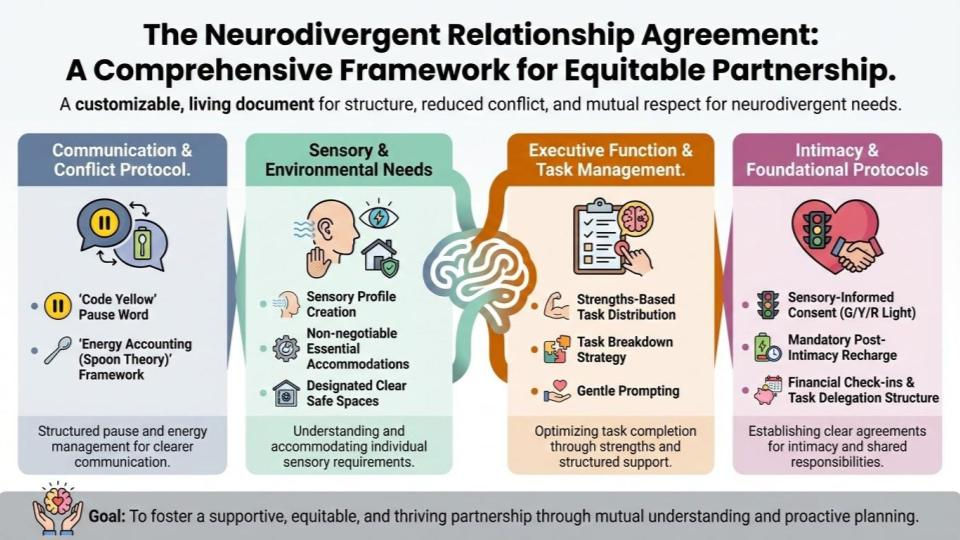
The Core Areas Every ND Couple Needs to Name
The agreement is organized into modules that reflect the real pressure points ND couples face—not the ones therapists assume.
Communication & Conflict
You’re creating shared language for moments when words get hard, processing speeds diverge, or emotions spike. This includes:
How you signal “I need space” without triggering abandonment
How you pause conflict without losing connection
How you communicate when you’re dysregulated or shut down
How you repair in ways that feel safe for both of you
This is about protecting the relationship, not policing each other.
Sensory & Environmental Needs
Your home should regulate you, not drain you. This section helps you name:
Light, sound, temperature, and texture needs
Sensory triggers that lead to overwhelm
What helps each of you regulate quickly
How to create sensory‑safe zones without shame
This is about building a home that supports your nervous systems.
Executive Function & Shared Labor
Task equity is not 50/50—it’s capacity‑based, strength‑based, and shame‑free. This section clarifies:
Who naturally excels at what
How reminders can be supportive instead of activating
What systems help each partner follow through
How to prevent resentment around chores, planning, or admin
This is about designing a partnership that works with your brains, not against them.
Intimacy, Connection, and Capacity
ND intimacy is deeply nuanced. This section helps you name:
Sensory preferences for touch, closeness, and space
How to communicate desire without pressure
How to navigate intimacy when capacity is low
How to reconnect after overwhelm
This is about honoring your bodies and your bandwidth.
Why This Agreement Changes Everything
When you stop interpreting neurodivergent traits as personal failings, the entire relationship softens. You stop fighting each other and start fighting for each other. You stop walking on eggshells and start walking with clarity.
A neurodivergent relationship agreement doesn’t make you “more normal.” It makes your relationship more yours.
It gives you a shared map for navigating complexity with care, dignity, and mutual respect.
If You’re Ready to Shift the Dynamic
You’re not failing. You’re navigating a relationship that requires more clarity than the culture ever taught you to create.
The Neurodivergent Relationship Agreement gives you a structure that honors your wiring, your needs, and your partnership. It’s a tool for couples who want to build something intentional, equitable, and deeply supportive.
When you’re ready, you can download the template and begin shaping a relationship that fits the two of you—not the world’s expectations.


Comments